Building safer communities through bystander intervention
A strong community is a safer community. At Lotus, one of the ways we work toward safety and connection is through the Green Dot program.
Green Dot is an evidence-based bystander intervention program that equips community members with practical tools to help prevent and reduce child abuse, sexual violence, and domestic violence. Bystander intervention is proven to work, and it reminds us that safety is a shared responsibility. Anyone can take action to support friends, family members, coworkers, and neighbors. Through Green Dot, we explore safe, realistic, and effective ways to provide support to others.
Green Dot’s impact is well documented. Research of the program in Kentucky high schools and colleges showed a 21% reduction in sexual assault perpetration and a 30% reduction in dating violence perpetration. These results illustrate that when communities learn how to look out for one another, meaningful change is possible.
How does Green Dot work?
Green Dot interventions are built around the 3 D’s: Direct, Delegate, and Distract. These options recognize that every situation is different and that personal safety always comes first. Bystanders can choose the approach that feels safest and most appropriate in the moment.
- Direct means addressing the behavior or checking in with the person who may be experiencing harm by setting a clear, firm boundary.
- Delegate involves getting help from others, like friends, staff, security, or trusted community members.
- Distract uses interruption or redirection to de-escalate a situation and create an opportunity for someone to leave safely.
There is no “right” way to intervene. Doing something, even something small, can make a difference.
Examples of the 3 D’s
Direct
Use clear, firm statements:
- “That’s not appropriate.”
- “That’s not okay.”
- “We don’t treat people like that here.”
Use support-centered check-ins with the person being targeted:
- “Are you okay?”
- “Do you know this person?”
- “Do you want to come with me?”
Delegate
Get help from others:
- Tell staff, security, or an authority figure what you’ve observed, or ask friends or bystanders for support:
- Something feels off—can you come with me to check in on this person?”
Distract
Create fake familiarity:
- “Do I know you? You look so familiar!”
Interrupt the interaction:
- “Excuse me, do you know where the bathroom is?”
- “I’m lost. Do you know how far it is to [place]?”
Create a disruption:
- Set off a car alarm
- Drop or spill something nearby
- Pretend to trip or need help
Creativity is encouraged. Any action that safely shifts attention and creates space for someone to leave can be effective.
Changing norms, together
The Green Dot program works to shift community norms by sending a clear message: violence in any form is not okay, and everyone can be part of the solution.
One of our Green Dot participants and volunteers, Issabella Cornett, shared her experience with Green Dot:
“For me, the training was really eye-opening and has had a big impact. I now know how to look for certain signs and signals that someone might be at risk, how to respond safely, and even which option works best for me as a bystander.
It has also been very beneficial for my job, since I work at an agency for substance abuse and policy prevention. I’m able to share what I’ve learned from the training with clients and use it to help support them in real situations.
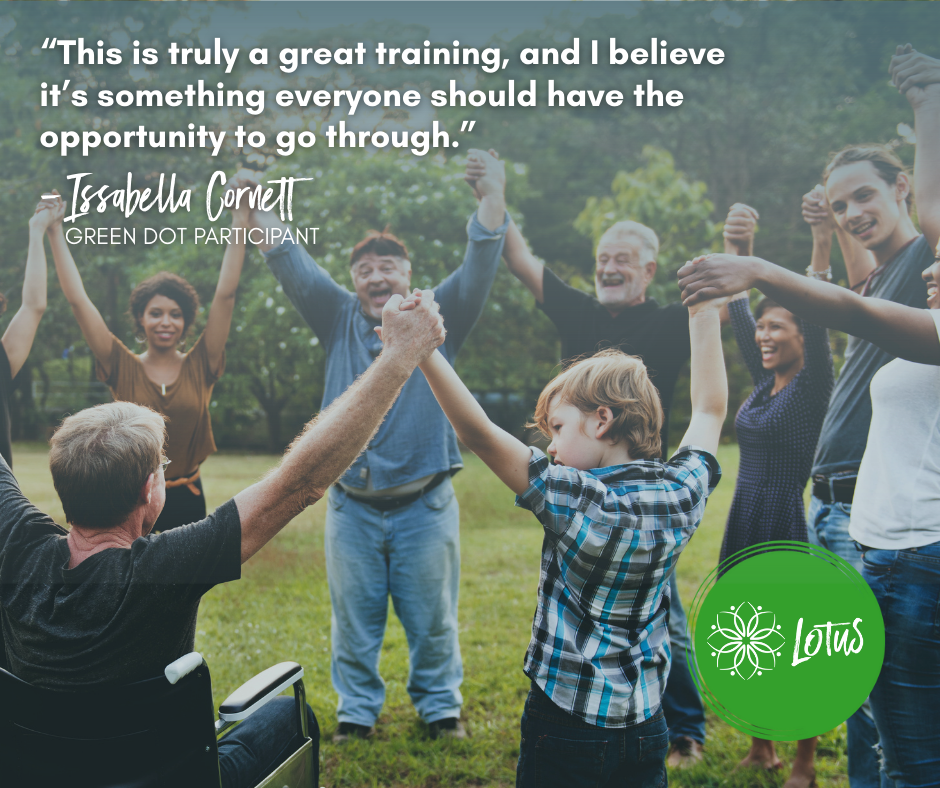
This is truly a great training, and I believe it’s something everyone should have the opportunity to go through.“
Get involved
Interested in bringing Green Dot to your organization, business, school, or club? You can contact Hadley Purcell at [email protected] to learn more or to schedule one for your group.
Together, we can build communities where people look out for one another, and where everyone has the opportunity to live, work, and connect in safety.